

Basketball is one of the fastest-moving sports in the world. A team can lead by 15 points in the first half, fall behind in the third quarter and still win the game with a strong finish.
If you regularly follow basketball live scores, understanding the numbers displayed on a scoreboard can make every game easier to follow.
Most basketball scoreboards display the current total score, the period being played, the remaining game time and, when available, the points scored during each quarter.
However, new fans may find terms such as Q1, Q2, Q3, Q4, HT, OT and Final confusing.
What does Q3 mean? How can a team win the fourth quarter but lose the game? Why does a basketball score sometimes change after the clock stops?
This guide explains how basketball live scores work, how to read every quarter and how to understand match results across competitions such as the NBA and international basketball.
What Is a Basketball Live Score?
A basketball live score shows the current points recorded by both teams during a game.
Unlike a final result, a live score changes as the match progresses.
For example, imagine a basketball game between Team A and Team B.
Team A 68–63 Team B — Q3
This means Team A currently has 68 points, Team B has 63 points and the game is in the third quarter.
Team A leads by five points, but the match has not finished.
As players score baskets and free throws, the scoreboard updates to reflect the latest recorded points.
Depending on the competition and sports data provider, a live basketball scoreboard may also display the game clock, individual quarter scores, timeouts, team fouls and other information.
Basketball fans can explore the Basketball Live Scores section on Sport Scores Live to check available fixtures, scores and completed results.
What Do Q1, Q2, Q3 and Q4 Mean in Basketball?
In most professional five-on-five basketball competitions, a regulation game is divided into four quarters.
Each quarter is a separate period of play.
The abbreviations Q1, Q2, Q3 and Q4 identify which quarter is currently being played or which period a particular score belongs to.
Basketball Quarter Abbreviations
| Abbreviation | Meaning | Description |
|---|---|---|
| Q1 | First Quarter | Opening period of the game |
| Q2 | Second Quarter | Final period before halftime |
| Q3 | Third Quarter | First period after halftime |
| Q4 | Fourth Quarter | Final period of regulation |
| HT | Halftime | Break between Q2 and Q3 |
| OT | Overtime | Additional period if regulation ends tied |
| FT / Final | Final Result | Game has officially finished |
Some websites use 1st, 2nd, 3rd and 4th instead of Q1 through Q4.
Others display the quarter number together with the remaining time, such as:
Q4 — 03:25
This indicates that the game is in the fourth quarter with three minutes and 25 seconds remaining.
The meaning is generally the same even when the scoreboard design differs.
How to Read a Basketball Quarter-by-Quarter Scoreboard
One of the easiest ways to understand a basketball match is to examine the points scored during each quarter.
Consider the following fictional basketball game.
Example: Team A vs Team B
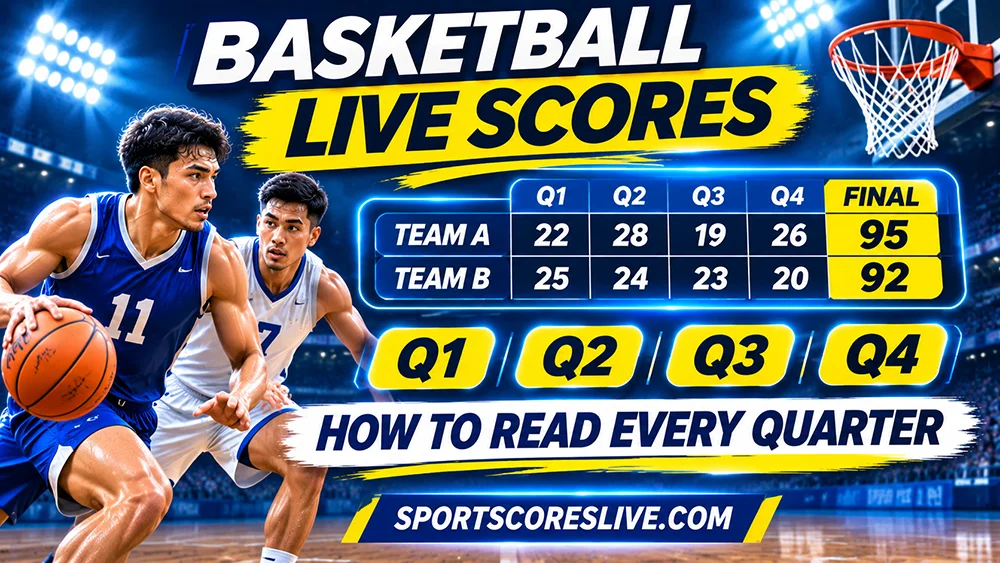
| Team | Q1 | Q2 | Q3 | Q4 | Total |
|---|---|---|---|---|---|
| Team A | 22 | 28 | 19 | 26 | 95 |
| Team B | 25 | 24 | 23 | 20 | 92 |
Final Result: Team A 95–92 Team B
This table contains the complete scoring breakdown for both teams.
Team A scored:
22 + 28 + 19 + 26 = 95 points
Team B scored:
25 + 24 + 23 + 20 = 92 points
Team A won the game by three points.
However, the quarter scores reveal more than the final result.
Team B performed better in the first and third quarters, while Team A scored more points in the second and fourth quarters.
This is why quarter-by-quarter statistics are useful when reviewing basketball games.
They help fans understand how the lead changed and which periods had the greatest influence on the result.
Understanding Q1: The First Quarter
Q1 is the opening quarter of a basketball game.
During this period, both teams begin executing their initial offensive and defensive strategies.
The first quarter can provide useful information about a team’s shooting performance, defensive organization and early momentum.
Using the previous example:
Q1: Team A 22–25 Team B
Team B scored three more points than Team A during the opening period.
Therefore, Team B led by three points at the end of Q1.
However, a first-quarter lead does not guarantee victory.
Basketball games can change quickly, especially when teams adjust their defensive tactics or introduce different player combinations.
A team that starts slowly may recover during the remaining three quarters.
What to Watch During Q1
The opening quarter can help fans identify several early trends.
These include shooting efficiency, turnovers, offensive rebounds, defensive pressure and whether either team is relying heavily on one scorer.
However, early performance is based on a limited number of possessions.
A team that makes several difficult shots during Q1 may not maintain the same scoring pace throughout the entire game.
Understanding Q2: The Second Quarter
Q2 is the second period of regulation and the final quarter before halftime.
By the beginning of Q2, teams have already seen how their opponents approached the opening period.
Coaches may adjust defensive assignments, introduce bench players or change offensive plays.
In our fictional example:
Q2: Team A 28–24 Team B
Team A scored four more points than Team B in the second quarter.
However, these are the points scored during Q2 alone.
To determine the halftime score, we must add each team’s Q1 and Q2 points.
How to Calculate the Halftime Score
For Team A:
22 + 28 = 50 points
For Team B:
25 + 24 = 49 points
The halftime score is therefore:
Team A 50–49 Team B — HT
Although Team B led after the first quarter, Team A moved ahead by one point before halftime.
This is an important distinction between quarter scores and cumulative game scores.
A team can win an individual quarter without necessarily leading the game overall.
What Does HT Mean in Basketball?
HT stands for Halftime.
It identifies the break between the second and third quarters in a standard four-quarter basketball game.
At halftime, both teams return to their respective dressing rooms or team areas to prepare for the second half.
Coaches may review the team’s performance, discuss defensive adjustments and prepare for the remaining periods.
When a scoreboard shows:
Team A 50–49 Team B — HT
The game is temporarily between halves.
The scores represent the total points accumulated during Q1 and Q2.
They do not represent the points scored in the second quarter alone.
Halftime Score vs Second-Quarter Score
| Statistic | Team A | Team B |
|---|---|---|
| First-quarter points | 22 | 25 |
| Second-quarter points | 28 | 24 |
| Halftime total | 50 | 49 |
This example shows why reading the correct scoreboard column matters.
If you mistakenly interpret the second-quarter score as the halftime result, you may misunderstand which team is leading.
Understanding Q3: The Third Quarter
Q3 is the first quarter played after halftime.
It often reveals how effectively the teams have adjusted their strategies during the break.
Some teams become more aggressive defensively, while others focus on moving the ball more efficiently or creating better shooting opportunities.
Using our example:
Q3: Team A 19–23 Team B
Team B scored four more points during Q3.
However, these points must be added to the halftime totals to determine the score after three quarters.
Team A:
50 + 19 = 69
Team B:
49 + 23 = 72
The score at the end of Q3 is:
Team A 69–72 Team B
Team B has moved ahead by three points.
Why Third-Quarter Scores Matter
The third quarter can reveal significant changes in momentum.
For example, a team that struggled defensively during the first half might reduce its opponent’s scoring opportunities after halftime.
Another team might improve its outside shooting or generate more points through fast breaks.
However, the third quarter does not decide the winner.
The fourth quarter still provides an opportunity for either side to take control.
Understanding Q4: The Fourth Quarter
Q4 is the final quarter of regulation.
For close games, this period often produces the most dramatic moments.
Teams may adjust their rotations, increase defensive pressure or use timeouts to organize important possessions.
In our example:
Q4: Team A 26–20 Team B
Team A outscored Team B by six points during the final quarter.
Before Q4, Team B led 72–69.
Adding the fourth-quarter points gives:
Team A: 69 + 26 = 95
Team B: 72 + 20 = 92
The final result becomes:
Team A 95–92 Team B
Team A recovered from a three-point deficit after Q3 and won by three points.
Can a Team Win Q4 but Still Lose the Game?
Yes.
Winning an individual quarter simply means scoring more points than the opponent during that period.
For example, imagine a team trails by 20 points after three quarters.
If it wins Q4 by ten points, it still loses the game by ten points.
To understand the overall result, always compare the cumulative scores rather than looking at an individual quarter in isolation.
Quarter Scores vs Total Basketball Scores
One of the most common mistakes when reading basketball live scores is confusing the points scored during a quarter with the cumulative game score.
A quarter score measures points recorded during one specific period.
The total score adds together every point scored since the beginning of the match.
Quarter Scores and Running Totals
Using the same fictional match:
| Game Stage | Team A Running Total | Team B Running Total |
|---|---|---|
| End of Q1 | 22 | 25 |
| Halftime | 50 | 49 |
| End of Q3 | 69 | 72 |
| End of Q4 | 95 | 92 |
Each row shows the cumulative score at that stage.
The points scored in the current quarter are only part of the total.
When viewing a live basketball scoreboard, first identify whether the displayed numbers represent the current overall score or the individual period breakdown.
How Do Basketball Teams Score Points?
Understanding basketball scoring is essential for interpreting changes on a live scoreboard.
In standard basketball, teams can score one, two or three points through different types of successful shots.
Basketball Scoring System
| Scoring Action | Points Awarded |
|---|---|
| Successful free throw | 1 |
| Successful two-point field goal | 2 |
| Successful three-point field goal | 3 |
A successful shot from inside the three-point line generally counts as two points.
A successful field goal from beyond the three-point line counts as three points, provided the shot meets the applicable rules.
A successful free throw counts as one point.
Example of a Live Score Change
Imagine Team A currently leads 72–70.
Team B makes a successful three-point shot.
The score becomes:
Team A 72–73 Team B
Team B has taken a one-point lead.
On the next possession, Team A scores a two-point basket.
The score changes to:
Team A 74–73 Team B
Basketball scores can change quickly because a single possession may produce multiple points.
In certain circumstances, additional free throws can also follow a successful field goal.
This is one reason basketball live scoreboards may update several times within a short period.
What Does the Basketball Game Clock Mean?
Most live basketball scoreboards display the time remaining in the current period.
For example:
Q4 — 02:15
This means the game is in the fourth quarter and two minutes and 15 seconds remain on the period clock.
The game clock generally counts down rather than counting upward.
It may stop during certain interruptions, including fouls, timeouts and other situations determined by the competition rules.
Game Clock vs Shot Clock
The game clock and shot clock have different purposes.
The game clock measures the remaining playing time in the current period.
The shot clock limits how long a team can retain possession before attempting a qualifying shot.
In NBA and standard FIBA basketball, the primary shot-clock period is 24 seconds, although it may be reset to a shorter interval in certain situations.
When reading a live score, do not confuse a number such as 08:35 on the game clock with a shot-clock display showing 12 seconds.
The two timers provide different information.
What Does OT Mean in Basketball Live Scores?
OT stands for Overtime.
Overtime is played when the teams have the same total score at the end of regulation and the competition requires a winner.
In the NBA and standard FIBA five-on-five basketball, overtime periods last five minutes.
If the teams remain tied after the first overtime period, additional overtime periods are played until a winner is determined.
Example of a Basketball Overtime Score
Imagine a separate fictional match finishes regulation with this score:
Team A 95–95 Team B
Because the teams are tied, the game proceeds to overtime.
During the first overtime period:
- Team A scores 11 points.
- Team B scores 8 points.
The final totals become:
Team A: 95 + 11 = 106
Team B: 95 + 8 = 103
Final Score: Team A 106–103 Team B — OT
The result shows that Team A won after one overtime period.
What Do OT1 and OT2 Mean?
Some scoreboards display OT1, OT2 or 2OT to identify multiple overtime periods.
| Abbreviation | Meaning |
|---|---|
| OT | Overtime |
| OT1 | First overtime |
| OT2 / 2OT | Second overtime |
| 3OT | Third overtime |
| Final/OT | Game completed after overtime |
Basketball games can continue through multiple overtime periods when necessary.
Unlike football, standard NBA and FIBA basketball does not use penalty shootouts to determine the winner of a tied game.
NBA vs FIBA: How Long Is Each Basketball Quarter?
Not every basketball competition uses the same regulation playing time.
The NBA follows a different quarter length from competitions using standard FIBA rules.
Basketball Quarter Duration Comparison
| Competition / Format | Quarter Length | Regulation Playing Time | Overtime |
|---|---|---|---|
| NBA | 12 minutes | 48 minutes | 5 minutes |
| FIBA basketball | 10 minutes | 40 minutes | 5 minutes |
| WNBA | 10 minutes | 40 minutes | 5 minutes |
| NCAA men’s Division I | Two 20-minute halves | 40 minutes | 5 minutes |
| NCAA women’s Division I | 10 minutes | 40 minutes | 5 minutes |
These are regulation game-clock durations, not the total amount of real-world time required to finish a game.
Timeouts, fouls, halftime and other interruptions make most basketball games last considerably longer than their regulation playing time.
Why Different Quarter Lengths Matter
NBA teams have 48 minutes of regulation play to accumulate points, while standard FIBA games have 40 minutes.
This difference can affect average game totals and the way fans compare scoring statistics across competitions.
For example, directly comparing the total points from an NBA game with a FIBA match may be misleading if you ignore the difference in playing time.
When analyzing scores across different leagues, consider both game duration and competition rules.
Also remember that not every form of basketball uses four quarters. NCAA men’s basketball uses two regulation halves, while 3×3 basketball follows a different format.
The scoreboard structure depends on the competition being played.
How to Know Which Team Is Winning a Basketball Game
In most situations, the team with the higher cumulative score is currently leading.
For example:
Team A 81–76 Team B — Q4
Team A leads by five points.
To calculate the lead, subtract the lower score from the higher score:
81 − 76 = 5
However, if the game is still in progress, the leading team has not necessarily won.
The opponent may still have time to score.
Understanding the Scoring Margin
| Score | Current Margin |
|---|---|
| 80–80 | Tied |
| 85–82 | First team leads by 3 |
| 92–85 | First team leads by 7 |
| 101–89 | First team leads by 12 |
A scoring margin helps show how close the game is.
However, the number of points separating the teams should be considered together with the remaining time.
A ten-point lead in Q1 is different from a ten-point lead with only a few seconds remaining in Q4.
Neither situation guarantees a particular final result while play is still ongoing.
What Does Final Mean in Basketball?
Final means the game has officially finished.
For example:
Team A 108–103 Team B — Final
This indicates that Team A won by five points.
If the game required overtime, some score providers may display a label such as Final/OT or Final/2OT.
Other platforms simply display Finished.
Live Score vs Final Score
| Status | Meaning |
|---|---|
| Scheduled | The match has not started |
| Q1–Q4 / In Progress | Regulation play is underway |
| Halftime | The match is between halves |
| OT / In Progress | Overtime is underway |
| Final / Finished | The game has ended |
| Postponed | The scheduled match has been delayed |
| Suspended | The game has been interrupted |
Some basketball data providers update the final status only after verifying the result.
A game clock reaching zero does not always mean that the website has already confirmed the official final score.
Late statistical corrections, reviews or data delays can affect the displayed information.
You can browse completed sports scores and results to review available finished basketball matches.
Why Basketball Live Scores Sometimes Update Late
Basketball live score services depend on information provided by official match systems, sports data suppliers or other reporting processes.
The speed and level of detail can vary between leagues and individual games.
Some competitions provide detailed play-by-play information and quarter scores.
Others may provide only the overall result or limited match statistics.
Possible reasons for delayed or incomplete basketball scores include data transmission issues, corrections to scoring events, temporary feed interruptions and differences in competition coverage.
What If a Completed Game Displays 0–0?
A completed basketball listing showing 0–0 should be treated carefully.
It may indicate that the expected scoring information has not been received or correctly displayed.
Do not automatically assume that a game actually finished without either team scoring.
If a final result appears inconsistent, cross-check it against the relevant league’s official records before drawing conclusions.
Similarly, if the quarter breakdown is missing, do not invent the individual quarter totals based only on the final score.
This distinction is especially important when reviewing historical games.
How to Follow Basketball Live Scores on Sport Scores Live
Sport Scores Live organizes basketball fixtures and results across available competitions.
You can use its basketball sections to check current match listings and browse available completed games.
Step 1: Open the Basketball Section
Visit the Basketball page.
The page displays available basketball competitions, fixtures and match statuses.
Step 2: Choose a Competition
Look for the league you want to follow.
The available competitions can include the NBA, NBA G League, NBL and other basketball tournaments.
Step 3: Check the Match Status
Identify whether the game is scheduled, in progress or finished.
If the match is live, check the latest displayed score.
Step 4: Open Available Match Details
Where the data provider supplies additional information, match details may help you understand how the game is progressing.
Not every game includes the same level of statistical coverage.
Step 5: Review Final Results
After the game has finished, use the Scores section to revisit the available final result.
For upcoming games, you can also explore the basketball match schedule to find scheduled fixtures.
If you want to follow currently active matches, visit the Live match center and check the available basketball score updates.
Game availability, update speed and additional statistics depend on the underlying match data.
Common Mistakes When Reading Basketball Scores
Understanding basketball scoreboards becomes easier once you recognize several common mistakes.
Mistake 1: Confusing Quarter Points With Total Points
The number shown under Q3 may represent only the points scored during the third quarter.
It is not necessarily the total score at that stage.
Mistake 2: Assuming the Halftime Leader Will Win
Basketball teams can recover from large deficits during the second half.
A halftime advantage does not guarantee victory.
Mistake 3: Ignoring Overtime
If a final result includes overtime, the total score may be higher than the score recorded at the end of regulation.
Mistake 4: Comparing Different Basketball Formats Without Context
NBA, FIBA, NCAA and other formats may use different game durations.
Raw point totals should be interpreted with those differences in mind.
Mistake 5: Treating an Incomplete Score as a Confirmed Result
Missing quarter statistics or an unusual score may reflect incomplete data rather than an actual game outcome.
Always confirm the match status and available official result.
Mistake 6: Assuming a Team Won Because It Won Q4
A team can outscore its opponent in the fourth quarter and still lose the game overall.
Only the cumulative final score determines the result.
Basketball Live Score Checklist
When following a basketball game, check the following information.
| Scoreboard Item | What to Look For |
|---|---|
| Teams | Confirm the correct matchup |
| Competition | Identify the league and its rules |
| Total score | See which team currently leads |
| Quarter | Check whether the game is in Q1, Q2, Q3 or Q4 |
| Game clock | Identify how much time remains |
| Quarter breakdown | Compare scoring during each period |
| Halftime score | Review the first-half totals |
| Overtime | Check whether extra periods were required |
| Match status | Distinguish live scores from completed results |
| Data availability | Confirm that displayed statistics are complete |
This simple approach helps fans understand the game without needing to follow every possession.
Frequently Asked Questions
What does Q1 mean in basketball live scores?
Q1 means the first quarter of a basketball game. It is the opening regulation period in competitions that use a four-quarter format.
What does Q2 mean in basketball?
Q2 means the second quarter. It is the final period before halftime in standard four-quarter basketball.
What does Q3 mean in basketball scores?
Q3 means the third quarter, which begins after the halftime break.
What does Q4 mean in basketball?
Q4 means the fourth quarter. It is the final period of regulation play in standard four-quarter basketball games.
How do you calculate a basketball halftime score?
Add the first-quarter and second-quarter points for each team.
For example, if a team scores 25 points in Q1 and 27 in Q2, its halftime total is 52 points.
Is the basketball quarter score the same as the total score?
No. A quarter score shows points scored during one specific period, while the total score includes all points accumulated throughout the game.
How long is one NBA quarter?
An NBA regulation quarter lasts 12 minutes. Four quarters provide 48 minutes of regulation playing time.
How long is a FIBA basketball quarter?
A standard FIBA basketball quarter lasts 10 minutes, resulting in 40 minutes of regulation playing time.
What does OT mean in basketball?
OT means overtime. It is an additional period played when the teams are tied at the end of regulation.
Can a basketball game have more than one overtime period?
Yes. In the NBA and standard FIBA basketball, additional overtime periods are played when the score remains tied after the previous overtime period.
Why does a basketball live score sometimes change after the clock stops?
The displayed score may be updated because of an official scoring decision, video review, statistical correction or delay in the sports data feed.
What is the difference between a live score and a final score?
A live score represents the current state of an ongoing game and can change. A final score represents the completed result after regulation and any necessary overtime periods.
Final Thoughts
Understanding basketball live scores is easier when you know how each quarter contributes to the overall result.
Q1 represents the opening quarter, Q2 completes the first half, Q3 begins the second half and Q4 finishes regulation.
Quarter scores reveal how teams perform during individual periods, while cumulative scores determine which team is leading and who ultimately wins.
Overtime adds another scoring period when a game remains tied after regulation.
By learning how to read the scoreboard, compare quarter totals and recognize match statuses, basketball fans can follow games with greater confidence.
Whether you enjoy the NBA, FIBA competitions or other basketball leagues, these basic concepts help you understand every stage of the game.
Explore Sport Scores Live to follow available basketball fixtures, check live scores and review completed results throughout the season.